
- Background
- Introduction to WiFi-7
- Comparisons between WiFi-5, WiFi-6/6E and WiFi-7
- Overview of Multi Link Operation (MLO)
- Multi Resource Unit (Multi-RU)/Puncturing
- References
Background
As many of you are aware that IEEE releases 802.11 standards and WiFi numbers are given to certain standard release of the 802.11 standard. Some of the old 802.11 standards and the Wifi generations are termed as follows
| WiFi Generation | IEEE Standard | Operating bands | Code name | Release Year |
| WiFi-1 | 802.11b | 2.4GHz | High Speed-2.4 (HS-2.4) | 1999 |
| WiFi-2 | 802.11a | 5GHz | High Speed-5 (HS-5) | 1999 |
| WiFi-3 | 802.11g | 2.4GHz & 5GHz | Higher Data rate (HDR) | 2003 |
| WiFi-4 | 802.11n | 2.4GHz & 5GHz | High Throughput (HT) | 2009 |
| WiFi-5 | 802.11ac | 5GHz | Very High Throughput (VHT) | 2013 |
| WiFi-6 | 802.11ax | 2.4GHz & 5GHz | High Efficiency (HE) | 2019 |
| WiFi-6E | 802.11ax | 6GHz | High Efficiency (HE) | 2021 |
| WIFi-7 | 802.11be | 2.4GHz, 5GHz & 6GHz | Extremely High Throughput (EHT) | 2024 |
| WiFi-8 | 802.11bn (Tentative) | 2.4GHz, 5GHz & 6GHz | Ultra High Reliability (UHR) | 2028 |
In each of the above standard releases from IEEE, some features are defined as mandatory to comply with the standard and some features are defined as optional. There is another organization called WiFi alliance (WFA) which defines WiFi generations with some additional clauses on top of mandatory features and optional features. This is a certification body. Vendors need to be complaint with WFA guidelines for it to be certified by WFA for that generation.
Although WiFi-7 is based on 802.11be, this standard itself is not finalized by IEEE. At the time of writing this article, A draft 4.0 of 802.11be is released and IEEE is aiming to finalize the standard by May 20241 .
Introduction to WiFi-7
WiFi-7 is going to be revolutionary as it introduces enhancements to both PHY and MAC layer. WiFi-7 enhancements are aimed at providing the following benefits
- Higher data rates (~23Gbps) and Throughput
- Higher efficiency in highly dense and congested networks
- Improved support for high throughput low latency applications
- Reduce power consumption
- Higher Reliability and Robustness
The key enhancements with WiFi-7 to achieve above benefits are as follows
- Multi Link operation (MLO) frame work
- Multi Link Single Radio (MLSR)
- Enhanced Multi Link Single Radio (eMLSR)
- Multi Link Multi Radio (MLMR)
- Simultaneous Transmit and Receive (STR) mode [also referred to as asynchronous MLMR (aMLMR)]
- Non-Simultaneous Transmit and Receive (NSTR) mode
- 4K QAM modulation (Introducing MCS 12 and MCS13)
- 320 MHz wider Channel bandwidth allowance
- Multi Resource unit (Multi-RU) allocation [also referred as Puncturing]
- Restricted Target Wake time(R-TWT) [also referred as Restricted Service period (RSP)]
- Multi-Link Security
- National Security and Emergency Preparedness (NSEP) priority access [also referred to as Emergency Preparedness and Communication Services (EPCS)]
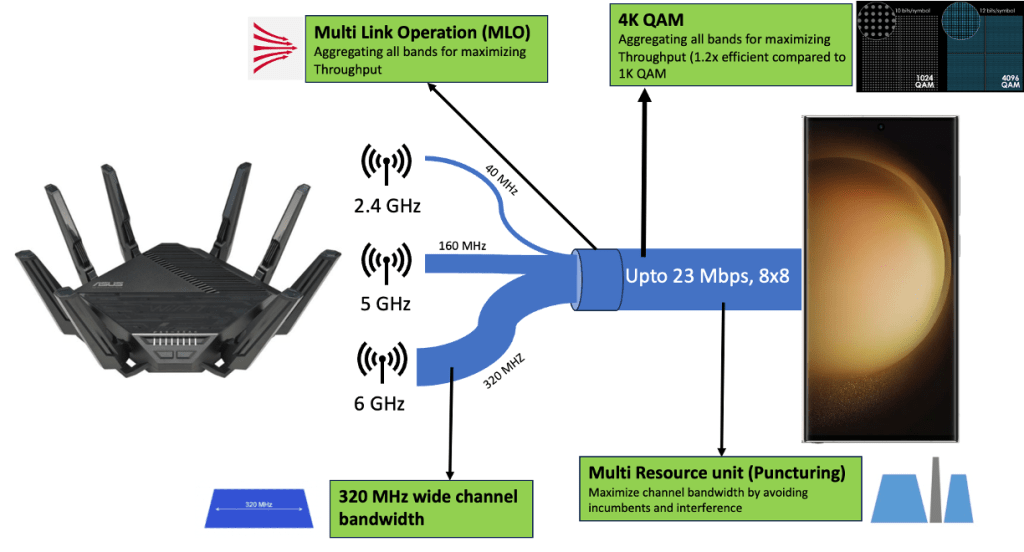
The use cases for WiFi-7 are as follows
- Virtual Reality (VR) communication
- Augmented Reality (AR) communication
- Increased Cloud computing needs
- Immersive gaming experience
- Remote Office experience
Comparisons between WiFi-5, WiFi-6/6E and WiFi-7
| Items | WiFi-5 | WiFi-6/6E | WIFi-7 |
| Max Channel Bandwidth | 160 MHz | 160 MHz | 320 MHz |
| Max Modulation | 256-QAM | 1024 QAM | 4096 QAM |
| Max Spatial Streams | 4 | 8 | 8 |
| Theoretical Max Data rate (Single Link) | ~3.46 Gbps | ~9.6 Gbps | ~23.05 Gbps |
| Access | OFDM | OFDMA | OFDMA |
| Security | WPA2 | supports WPA3 | supports WPA3 |
| MIMO capabilities | DL MU-MIMO | UL+DL MU-MIMO | UL+DL MU-MIMO |
| Resource Allocation | – | Single-RU | Multi-RU |
| Key Features | Mandatory 40MHz | TWT, BSS coloring | MLO, Multi-RU |
Overview of Multi Link Operation (MLO)
MLO is a revolutionary feature introduced in 802.11be standard and this introduction completely redesigns the MAC layer to support per packet level Link aggregation
MLO is a form of Link aggregation. There has been a lot of Link aggregation algorithms proposed. Some algorithms operate at layer-3 while some operate at Layer-4. There has been a standard called Dual Band Simultaneous (DBS) which provides guidance on the usage of 2.4GHz and 5GHz bands together. This has its challenges as thius aggregation cannot be on per packet basis but per connection basis. (Please let me know in the comments if you want me elaborate on DBS in a separate Article). MLO solves this problem and this link aggregation can be as granular as per packet basis as the aggregation Occurs at layer-2.
Multi Link Single Radio (MLSR)
MLSR is a method of MLO where the client devices can associate and maintain connection across multiple bands with the Access Point (AP) at the same time but the communication between AP and the client can occur only on a single band at any given time.
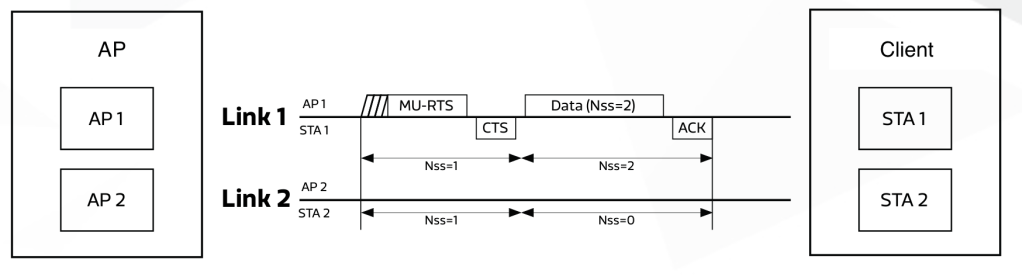
There is an Enhanced version of MLSR where the number of radio chains can be seamlessly altered based on the availabilty and requirement.
Multi Link Multi Radio – Simultaneous Receive and Transmit (STR-MLMR)
MLMR is another method of MLO. MLMR has 2 sub flavors and one of them is STR-MLMR. This method is also termed as asynchronous MLMR aka aMLMR.
From the title, MLMR means communication can happen between client and AP on multiple bands at any given time. STR-MLMR allows the communication between client and AP on one band without any restriction from the operation on other bands that are part of MLO
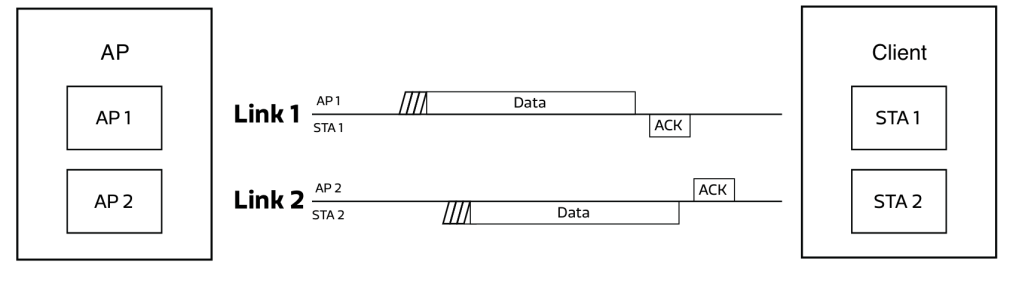
Most vendors are expected to only support this flavor of MLO as STR-MLMR is easy to implement and has the potential to take advantage of the available air time efficiently.
Multi Link Multi Radio – Non-Simultaneous Receive and Transmit (NSTR-MLMR)
Unlike STR-MLMR, NSTR-MLMR places a restriction on the operation of one band based on the operation on other bands that are part of MLO. This flavor restricts the AP and client to either transmit or receive on all the bands of MLO at any given time. Transmitting on one band while receiving on other band is prohibited when operating in NSTR mode of MLO.
When transmitting in multiple bands, it is necessary to coordinate the PPDU end times for synchronization across bands.
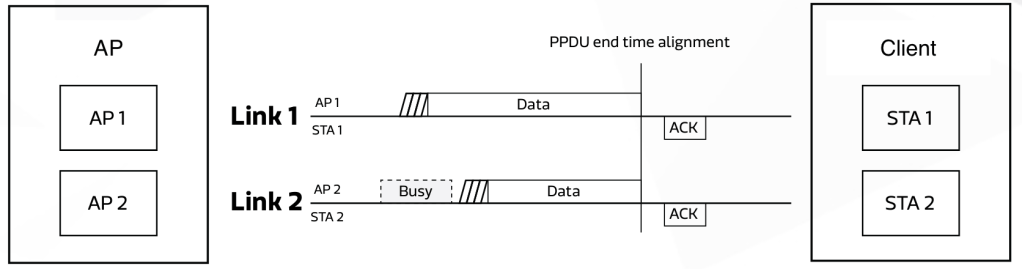
NSTR-MLMR is a complex algorithm to implement both on the client and AP side. I dont see any vendors favoring this flavor of MLO in their initial releases. This flavor of MLO also dont utilize the air time efficiently as all bands have to wait until every band is clear to send or atleast align such that end times can be aligned.
Multi Resource Unit (Multi-RU)/Puncturing
Puncturing is actually not a new feature introduced in 802.11be. This feature is introduced in 802.11ax but 802.11be mandates the support for puncturing in 802.11be along with some enhancements to this feature.
Puncturing allows the communication to be more robust when incumbents are interference is introduced at certain frequency of the operating bandwidth.
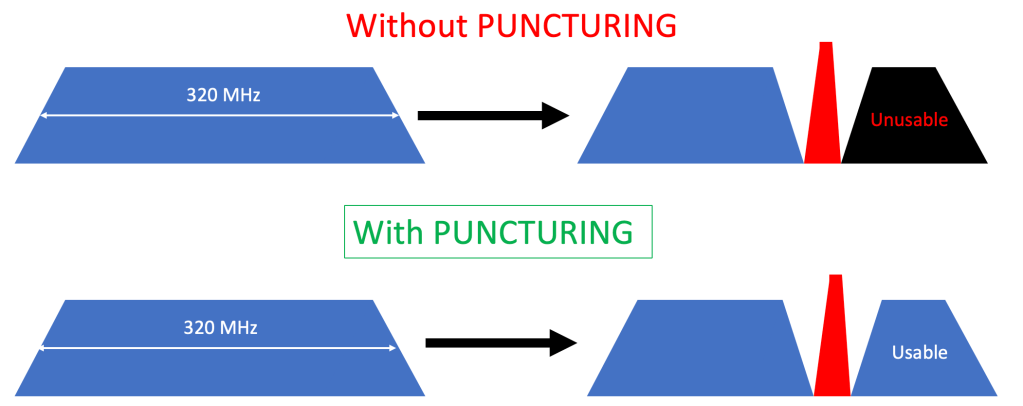
As shown in the above picture, when a certain incumbent is introduced in the operating bandwidth, Legacy operations reduce the operating bandwidth in half avoiding the other half containing interference/incumbents. This results in reduction of the operating throughput in Half.
Instead, Multi-RU capability provides a way of just avoiding the frequencies with incumbents/interference. Puncturing can be performed at a granularity of 20MHz bandwidth. So, if a certain 20MHz is unusable when operating with 320 MHz bandwith, puncturing provides a way to operate in the remaining 300MHz of bandwidth omitting the problematic 20 MHz. This greatly increases the reliabilty and adapts to the incumbents and interference.
As this article is intended to be an overview of WiFi-7, the features are discussed at very high level. If you want to learn in depth about ways of operating MLO, beaconing with MLO, security with MLO, Puncturing, Restricted TWT and NSEP priority services, please comment what you want to learn about next.
References
3. https://standards.ieee.org/ieee/802.11ax/7180/
 WWDKS - Wireless With Dileep Kumar Soma
Leave a comment