Table of Contents
- Intended Audience and Overview:
- Introduction
- What is MBSSID and How will it work?
- What is the problem MBSSID is solving?
- Is MBSSID only allowed on 6GHz band?
- Is MBSSID a new feature introduced in 802.11ax?
- Can you have same SSID string for multiple VAPs as part of MBSSID field?
- How is MBSSID field defined to be implemented in the standards?
- Is there a limitation on how many VAPs can be part of MBSSID element?
- What is included in the MBSSID field in the beacon frames?
- What is Excluded in the MBSSID field in the beacon frames?
- How is each BSSID included in the MBSSID element
- About the author
- References
Intended Audience and Overview:
This article is intended for audience who is wondering what is Multiple BSSID (shortly known as MBSSID) field in Wi-Fi networks and provides a theoretical overview of MBSSID as defined in the latest standards (up to 802.11ax-2021) and answer some basic question I had when learning about MBSSID.
This article assumes the reader having some wireless basics including meaning of SSID, BSSID, a beacon, 802.11 standards etc.,
This article will be in a Question and Answer format as I believe that every great innovation, invention and discovery started with a Question.
There will be a part2: PCAP analysis of the MBSSID which details about each sub field in the MBSSID field and implementation mechanisms.
Introduction
In the ever-evolving world of wireless networking, advancements are continually being made to improve the efficiency and functionality of Wi-Fi networks. One of such advancements is the introduction of Multiple BSSID field.
When you are searching for a network to connect to, you can see many SSIDs that are available for you to connect. If you see 10 SSIDs in your network discovery, does that mean, there are 10 routers around you? Not necessarilty, A single router is capable of transmitting multiple SSIDs on a single band/Radio. Each SSID may have its own beacon, security configuraions but Radio capabilities for all these SSIDs stays the same. Why? Because although these SSIDs are all different, these are catered by a single Radio which will operate with certain defined capabilities which will be constant across all SSIDs (or Virtual APs) created on this Radio.
What is MBSSID and How will it work?
Multi BSSID allows a single physical access point to act as multiple virtual access points (VAPs), each with its own unique network configuration and security settings. MBSSID field lets the AP transmit these multiple VAPs as part of a single beacon.
The picture below gives an overview of how multiple VAPs are transmitted with and without the use of MBSSID field.
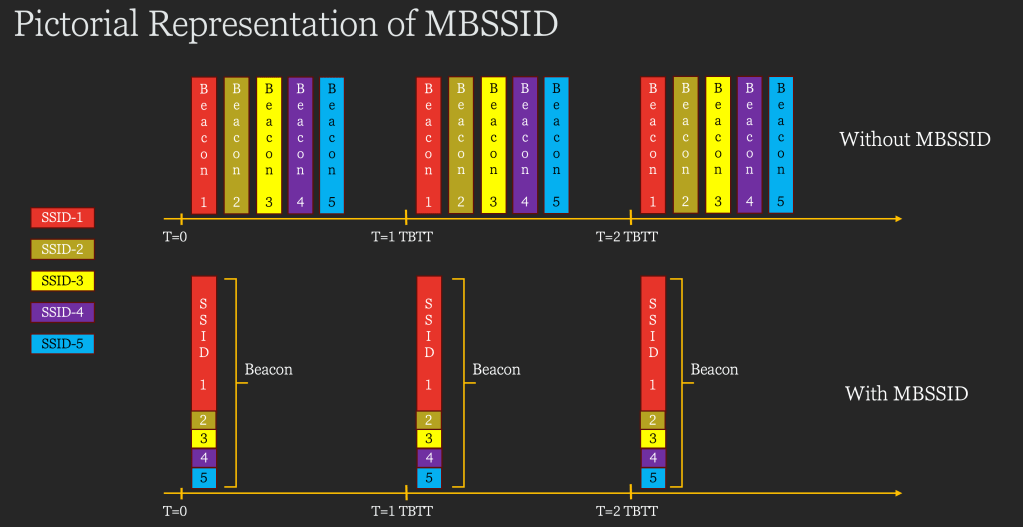
Figure-1: Visual representation of Multi VAPs transmission with and without MBSSID field
SSIDs 1, 2, 3, 4 & 5 are 5 VAPs created on the same band. As depicted in the picture, without MBSSID field, each VAP transmits its own beacon. With MBSSID field, all VAPs are concatenated onto a single Beacon.
SSID-1 is termed as Transmitted BSSID
SSID-2,3,4 &5 are termed as Non-transmitted BSSIDs
What is the problem MBSSID is solving?
As shown in Figure-1, Each beacon carries its SSID. The congestion created by beacons are termed as ‘Beacon overhead’. As the number of beacons increase, beacon overhead increases linear. Although overhead is linear with number of beacons, as the number of beacons increase, the drop in effective throughput will be exponential due to the listen before talk nature of Wi-Fi.
MBSSID field is introduced to concatenate multiple VAPs on a single band to transmit as a single beacon. Full length of all VAPs are not concatenated as part of MBSSID. Common information for all VAPs is present in the main beacon and can be inherited for each VAP by the clients. By implementing it this way, MBSSID reduces Beacon overhead thereby contributing to the usage of air time efficiently.
What is the percentage of Beacon overhead reduction with MBSSID?
This answer to this question is not straight forward as the percentage of Beacon overhead reduction depends on the following
- Number of VAPs in the MBSSID field
- VAP information included (partial/ full)
Frame length of the beacon is increased with the addition of MBSSID field but is lower than the sum of beacon lengths of individual VAPs.
It is estimated that beacon overhead is reduced by anywhere between 20% to 50% per VAP in the MBSSID field based on the implementation.
Is MBSSID only allowed on 6GHz band?
MBSSID field is not exclusive to 6GHz band. There is a common misconception that MBSSID field can not be used in 2.4GHz or 5GHz band. That is completely wrong.
MBSSID field is allowed on all operating bands of Wi-Fi.
Is MBSSID a new feature introduced in 802.11ax?
This is another common misconception that this feature is introduced as part of 802.11ax (also known as Wi-Fi6).
This feature falls under various amendments to the standard, including IEEE 802.11-2007, IEEE 802.11n-2009, IEEE 802.11ac-2013, and subsequent revisions.
802.11ax amendment made it mandatory for the client devices to recognize MBSSID field along with some revisions to previously introduced MBSSID field.
Can you have same SSID string for multiple VAPs as part of MBSSID field?
The answer is yes when we talk strictly from the standards perspective. 802.11 documentation dont ban usage of same SSID string for multiple VAPs as part of MBSSID field
However, WiFi Alliance (WFA) (another standards body that certifies devices) explicitly bans the use of same SSID string for multiple VAPs that are part of the MBSSID field.
How is MBSSID field defined to be implemented in the standards?
MBSSID is defined as one of the elements in the 802.11 standards as part of Management frames.
As an element, MBSSID is not confined to be used in beacon only. MBSSID field can be utilized in the probe response and probe request frames by the capable devices as part of the management frames
To understand the structure of MBSSID field, you need to undestand how any element is defined in the standards. Any element field is defined in the format as shown in the picture below1

Figure-2: Showing general format of any element in 802.11
MBSSID element format is as shown in the picture below1

Figure-3: Showing MBSSID format defined in 802.11
For an element to be identified as an MBSSID element, the element ID is set to 71.
Is there a limitation on how many VAPs can be part of MBSSID element?
MaxBSSIDIndicator subfield of the MBSSID element is assigned a value of ‘n’ where 2n is the maximum number of BSSIDs present in the MBSSID set. The value of ‘n’ can not be greater than 8.
Although, any chip vendor in pratical wont allow more than 16 VAPs on a given radio. That puts a practical limitation of ‘n’ value to be maximum of 4.
The actual number of BSSIDs carried is not explicity signalled.
What is included in the MBSSID field in the beacon frames?
The Multi BSSID element within beacon frames contains several identifiers that define the characteristics of each VAP. These identifiers help differentiate and configure the virtual SSIDs. Here’s a breakdown of the key identifiers typically found within the Multi BSSID element:
| Identifier | Description |
|---|---|
| BSSID Information | Unique MAC address associated with the VAP. |
| SSID Information | The Service Set Identifier (SSID) of the VAP. |
| Flags | Flags that specify attributes of the VAP, such as its security settings. |
What is Excluded in the MBSSID field in the beacon frames?
There are many elements that are excluded from the MBSSID element. Notable elements among those excluded are the following (please refer 802.11ax-20212 for the complete list of elements excluded).
- Time Stamp and Beacon Interval Fields
- Country code
- (Extended) Channel Switch Announcements
- Wide bandwidth Channel switch
- Transmit power Envelope
- Supported operating Classes
- Reduced Neighbor Report (RNR)
- BSS color cahnge Announcement
- ERP information
- HT capabilities
- HT operation
- VHT capabilities
- VHT operation
How is each BSSID included in the MBSSID element
Explaining the way fields defined in the standard is a little complex compared to the theme of this particular article. I will cover the details of this topic as part of the article “Understanding Multi BSSID (MBSSID) in Wi-Fi networks – Part3: Field format”.
MBSSID is one of the very important inclusion in the 802.11 amendment. This will play a very key role in the upcoming future where multipple VAPs are required (Ex: Multi Dwelling units, public SSID(s)). I will discuss about the
About the author
Dileep Kumar Soma is the author of this article. He has been pursing Wi-Fi related technologies for the past 8 years and is considered as an expert in the field of wireless networking. He have a deeper theoretical and implementation knowledge of Wi-Fi networks which enables him to go deeper on any topic in the field of Wi-Fi.
LinkedIn: https://www.linkedin.com/in/somadileepkumar/
Please email if you have any questions to wirelesswithdileepkumarsoma@gmail.com
Key words: Multiple BSSID, SSID, SSID set, BSSID, MBSSID, mbssid, 802.11, 802.11ax, Wi-Fi6, Wifi6, Wifi, Wi-Fi, Beacon overhead, overhead, spatial, transmitted, non-transmitted, transmitted SSID, transmsitted BSSID, non-transmitted SSID, non-transmitted BSSID, RNR, Reduced neighbor reports, BSS set, BSS color.

 WWDKS - Wireless With Dileep Kumar Soma
Leave a comment